

Mercer Island presents a construction environment that does not behave like the rest of King County. It is a 13 square mile landmass connected to the mainland by a single freeway corridor, governed by its own municipal code, and characterized by parcels that frequently combine steep slopes, mature tree canopy, and shoreline jurisdiction. The result is a project envelope where logistics, regulation, and structural engineering carry equal weight to design intent. A homeowner who treats a Mercer Island remodel like a Bellevue or Kirkland project will encounter cost overruns, schedule delays, and permit denials that would not occur ten miles away.
This is the operational reality that defines Mercer Island home remodeling. The work demands a firm that has navigated MICC variance hearings, coordinated material deliveries against I-90 closure schedules, and executed structural underpinning on lots with 30 percent grade. General market experience does not transfer cleanly to this jurisdiction.
The Island Context: Logistics Under Constraint
Every material, every crew, and every piece of equipment that reaches a Mercer Island job site crosses one of two bridges. The I-90 corridor handles the entirety of vehicular access, and its operational status is not a constant. Lane closures for East Link light rail integration, weekend maintenance windows, and unscheduled incidents produce delivery delays that must be absorbed by the project schedule. A contractor who relies on same day material runs from Kent or Sumner will lose two to four hours per occurrence.
The correct response is staged procurement. Framing packages, tile pallets, cabinetry crates, and finish materials are delivered to the site in scheduled batches that align with the construction sequence. This requires storage capacity, which itself is constrained. Mercer Island lots are frequently narrow at the street frontage, with mature landscaping and limited driveway depth. Job site staging must be planned in three dimensions, often using temporary container units placed within the buildable footprint.
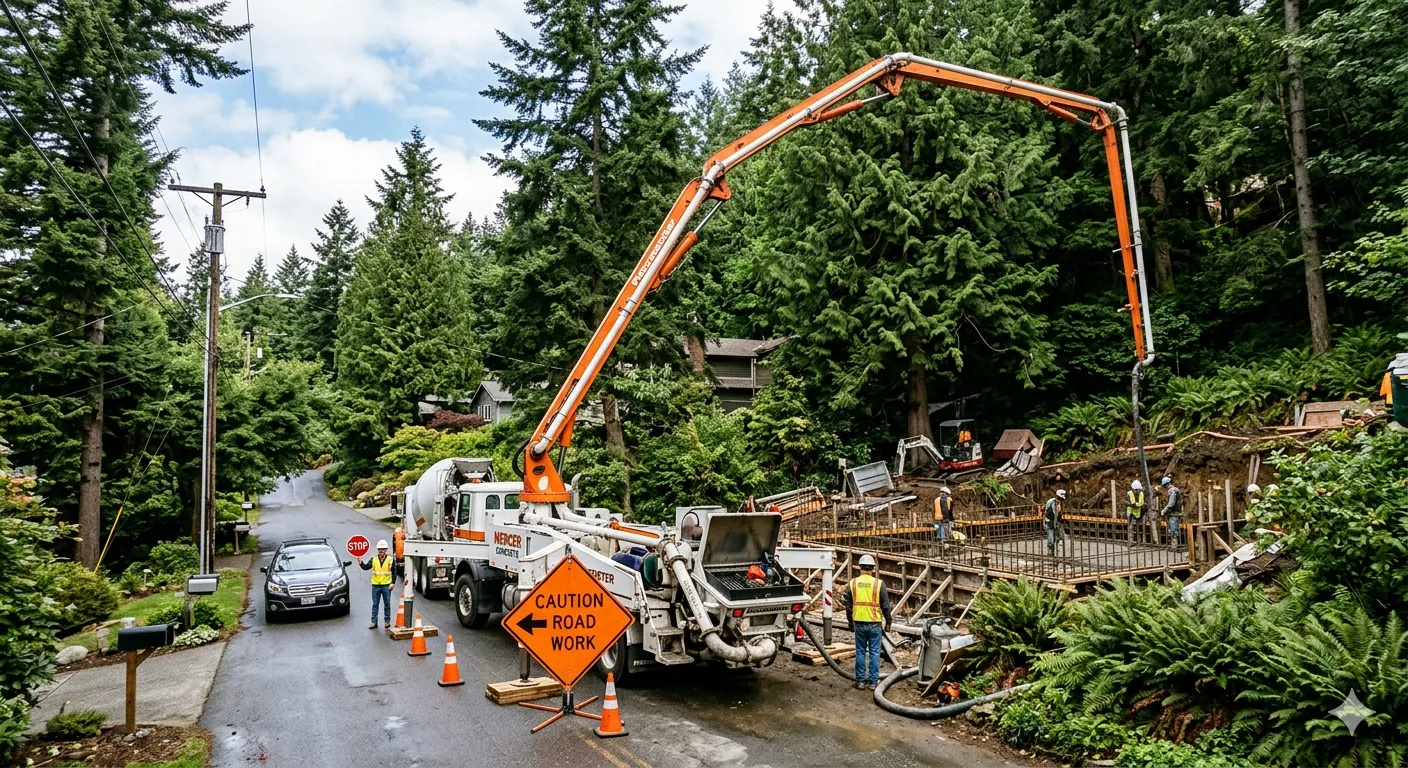
Site access compounds the problem. Many Mercer Island streets, particularly on the south end and along the western shoreline, are narrow, lack curbs, and carry cul de sac terminations that prevent semi truck access. Boom truck deliveries for trusses, structural steel, and stone slabs require pre coordinated traffic control. Concrete pours on shoreline parcels sometimes require pump trucks staged 150 to 300 feet from the placement, which drives material loss and cures the slab under non ideal conditions if not managed.
Regulatory Complexity: MICC and the Shoreline Master Program
The Mercer Island City Code is not a derivative of the King County code. It is a parcel level regulatory framework with its own definitions, setbacks, height limits, and review processes. Section MICC 19.02 governs residential development standards, and the numerical limits it imposes drive design decisions that would be unconstrained on a mainland lot.
Impervious surface ratio is the first variable most homeowners do not anticipate. Mercer Island restricts the percentage of a lot that can be covered by buildings, driveways, patios, and other non permeable surfaces. On many parcels, the existing condition is already at or near the maximum. Adding a 400 square foot addition or a new patio without compensating with permeable pavers, green roof assemblies, or removal of existing impervious area triggers a code violation. Calculations must be run at the schematic design stage, not after permit submittal.
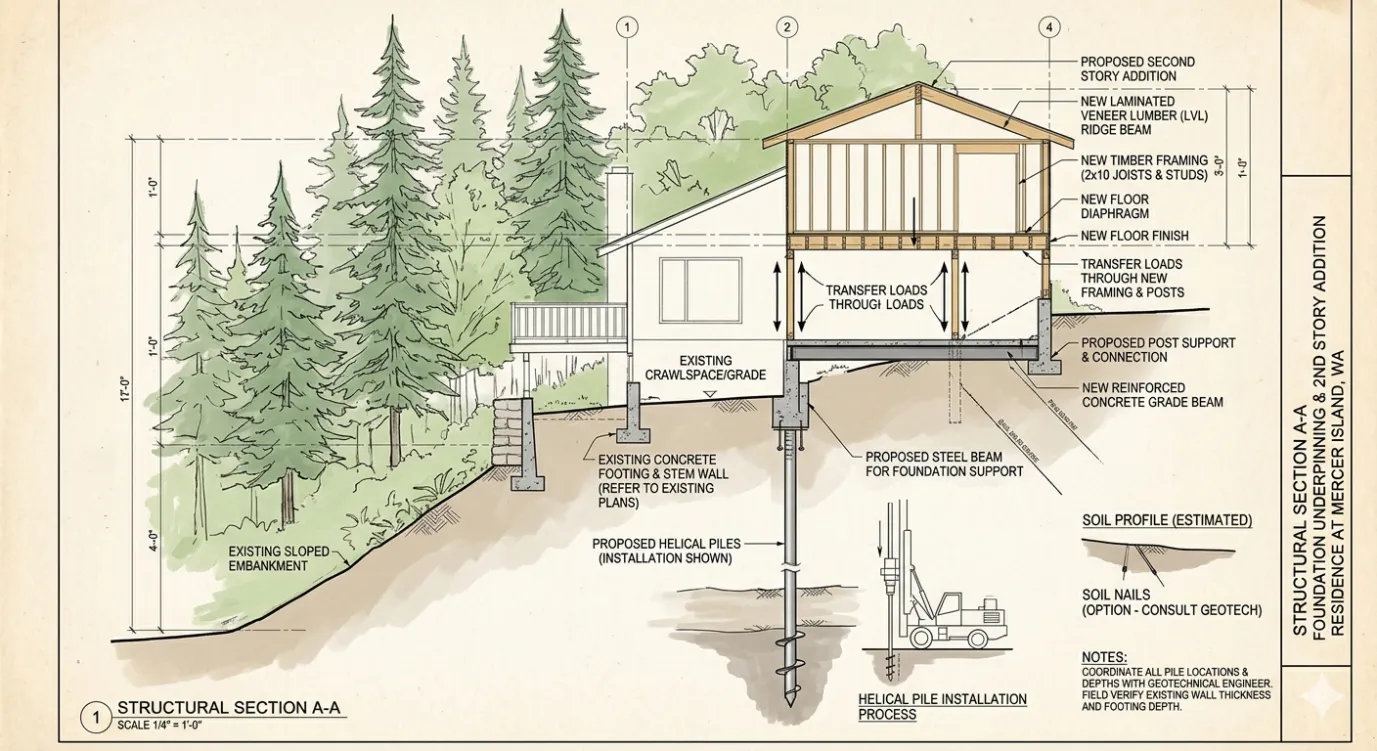
Steep slope regulations layer additional complexity. Any portion of a parcel with grade exceeding 15 percent falls under critical area review. Construction within or adjacent to these zones requires a geotechnical report, slope stability analysis, and frequently a peer review by a city retained engineer. Foundation systems on steep slopes commonly require pin piles, helical anchors, or soldier pile retaining walls that drive structural costs significantly above a flat lot equivalent.
Waterfront parcels add the Shoreline Master Program. Properties within 200 feet of the ordinary high water mark of Lake Washington fall under SMP jurisdiction, which regulates buffer zones, vegetation management, dock modifications, and the specifics of any work that affects the shoreline environment. Permit timelines extend by 60 to 120 days when shoreline review is required.
Navigating these regulatory constraints requires a structural remodeling contractor where architecture and engineering are unified under a single accountability structure. When the design team integrates MICC impervious calculations with the geotechnical report and sequences work against shoreline buffer requirements, the project advances through permitting and construction without the oversight gaps found in fragmented contracting models.
Structural Engineering: Foundation and Utility Analysis
Mercer Island’s housing stock spans seven decades. Mid century daylight basements, 1980s split levels, and recent contemporary builds coexist on adjacent lots. Each generation carries its own structural assumptions, and a remodel that adds load, modifies the footprint, or expands vertically must reconcile the existing structure against current code.
A second story addition over a 1962 ranch is not a simple framing exercise. The existing foundation was designed for a single story load with original Lake Washington fill conditions that may not meet current geotechnical standards. Engineering analysis frequently identifies the need for foundation underpinning, supplemental footings, or full foundation replacement before the new framing can be permitted. Seismic retrofitting at the same time is logical because the structure is already exposed.
Utility capacity is the second analysis. The existing water service from the meter to the house may be three quarter inch galvanized or one inch polybutylene, neither of which supports the fixture count of an expanded floor plan with multiple bathrooms and a modern kitchen. Electrical service panels at 100 or 125 amps are routinely undersized for whole home remodels that add HVAC capacity, EV charging, induction cooking, and heat pump water heaters. Service upgrades to 200 or 400 amps require coordination with PSE, which has its own scheduling constraints on the island.
Fixed Cost Discipline in a High Stakes Environment
Traditional cost plus and time and materials contracts transfer financial risk to the homeowner. On a Mercer Island project, where total scope frequently exceeds 800,000 dollars and unforeseen conditions are common, that risk transfer produces budget outcomes that exceed initial estimates by 20 to 40 percent.
A fixed cost contract reverses the incentive structure. The contractor absorbs the risk of estimation errors, schedule overruns, and standard unforeseen conditions, which forces a level of pre construction diligence that cost plus structures do not require. Site investigations are more thorough. Engineering analysis is completed before contract execution. Permit timelines are factored into the schedule with realistic buffers. The homeowner receives a number that does not move, and the contractor receives a project where the scope is frozen before demolition begins.
This discipline is not a financial preference. On Mercer Island, where logistics, regulation, and structure each carry independent risk, fixed cost is the only contract structure that aligns the project team with the homeowner’s interest in predictable execution.