

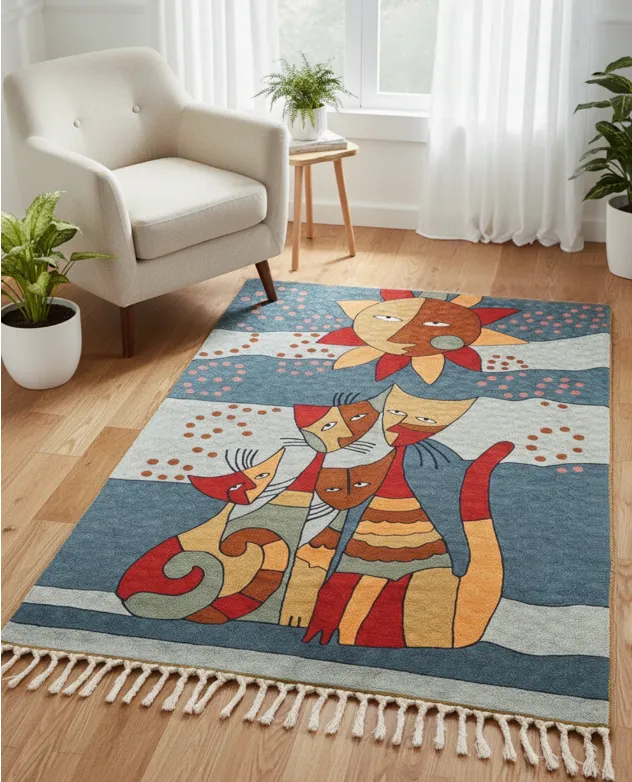
Most people buy hallway carpets after decorating everything else. The living room gets the nice Persian rug. The bedroom gets the soft wool rug. And the hallway?
Whatever is left.
That is a mistake.
Your hallway may be the hardest-working strip of flooring in the house. People walk through it with outdoor footwear. Children run through it. Bags are dragged across it. Dust travels through it. Guests enter through it. In many Indian homes, the hallway also connects the main entrance, bedrooms, and living spaces.
Yet people still choose hallway carpets the same way they choose decorative rugs: “Does this look nice?”
Wrong first question. The right question is: What exactly will happen on this carpet every day?
A hallway carpet has a tougher job than most rugs in the house. It needs to work with the movement, the mess and the shape of the passage without becoming another thing you constantly have to straighten, clean or worry about. That is why the best hallway carpet is not necessarily the softest or most expensive one.
It is the one that survives the traffic without making the hallway harder to use.
Should Hallway Carpets Be Soft or Durable?
For most Indian homes, durability should come before softness because a hallway is a traffic zone, not a barefoot relaxation zone.
This is the biggest mistake buyers make.
A thick, plush carpet may feel luxurious in a bedroom, but the same surface can become impractical in a busy passage where dust, footwear and regular movement are involved.
Hallway carpets need to handle repeated foot traffic.
A practical hallway carpet should usually have:
- Low or medium pile.
- A stable, easy-to-walk-on surface.
- Good resistance to regular wear.
- A texture that can be vacuumed without excessive effort.
- A secure grip or anti-slip support underneath.
Flatwoven rugs are particularly relevant for busy areas because their lower-profile surface is generally easier to vacuum. Kesari Home’s current India range also specifically positions flatwoven options for busy hallways.
Softer hallway carpets work better when:
- The passage has low foot traffic.
- It is away from the main entrance.
- People usually walk through without footwear.
- The hallway functions more like an interior corridor.
Prioritise durability when:
- The hallway connects directly to the entrance.
- Children frequently run through it.
- Footwear is carried through the space.
- The area receives regular dust from an open balcony or door.
- The carpet sits on a major route between rooms.
Key note: A hallway carpet should feel good underfoot, but it should not behave like a high-maintenance bedroom rug.
How Long Should a Hallway Carpet Be?
A hallway carpet should follow the useful walking zone, but it should not stretch from wall to wall as if the passage has been carpeted permanently. Most generic guides tell you to measure the hallway. That is incomplete advice. You need to measure the walking path.
If the hallway contains:
- A shoe cabinet.
- Doors that open outward.
- A console.
- A storage unit.
- A narrow turn.
then the usable passage may be very different from the room’s full dimensions.
A hallway runner usually works best when:
- It leaves visible flooring on both sides.
- It does not block door movement.
- It follows the natural direction of the passage.
- It covers the area where people actually walk.
Common hallway runner dimensions available in current Indian retail ranges include lengths such as 150 cm, 180 cm and 200 cm, giving buyers options beyond one standard size.
Avoid a hallway carpet that:
- Nearly touches both walls.
- Ends awkwardly in the middle of a doorway.
- Gets caught under a door.
- Is so narrow that people constantly step around it.
- Is so wide that the passage feels tighter.
The best hallway carpet should make the passage feel longer and more intentional, not narrower and more crowded.
Should Hallway Carpets Start Right at the Front Door?
Not always. A hallway carpet should begin after the dirtiest part of the entry process has been handled. This is especially relevant in Indian homes. If people enter directly from outside and walk onto your carpet with dusty or wet footwear, you are asking the rug to perform a job that a proper entry mat should handle first.
There is a difference between:
- A door mat, which handles dirt at the entrance.
- A hallway carpet, which improves the interior passage.
Current hallway products and guidance continue to separate these functions, with more durable options positioned for entrances and runners for interior circulation.
A smarter setup is:
Step 1: Outdoor or entrance mat
Handles the first layer of dirt and moisture.
Step 2: Shoe management zone
Creates a place for footwear, especially if shoes are removed near the entrance.
Step 3: Hallway carpet or runner
Adds warmth, comfort and visual continuity to the interior.
This setup makes much more sense than placing one beautiful carpet directly where all the outdoor mess enters.
A hallway carpet should decorate the movement inside your home, not become the first battlefield against everything coming from outside.
What Makes a Good Hallway Carpet?
A good hallway carpet makes one of the busiest parts of the home feel more comfortable without becoming another thing that needs constant attention.
Before buying, ask:
- Where does most of the dust enter?
- Do people walk here with footwear?
- Which doors open across this space?
- What is the actual walking path?
- How often can I realistically clean the carpet?
- Will the rug stay secure under regular movement?
- Does the shape support the passage?
The biggest shift in thinking is simple: Do not buy hallway carpets to fill empty floor. Buy them to improve a path people use every single day.
Because a hallway is not really a room you stop and admire. It is a route. And the handmade carpet needs to respect that.